


Most families looking for admissions consulting start the search after one specific moment — a conversation at the kitchen table where the size of what is ahead suddenly clicks. Junior year is heavier than tenth grade. Test plans are due. Course-rigor decisions for senior year cannot wait until summer. Activities need to actually mean something. The college list has to start narrowing. And nobody in the house has the bandwidth or the recent experience to manage all of it well.
That moment is what good admissions consulting is built for. The point of hiring a consultant is not to outsource your child’s college process — it is to install a real process where there wasn’t one yet.
What Admissions Consulting Is — and What It Is Not
Independent admissions consulting is a structured, multi-year (or at minimum, multi-semester) partnership with a professional who plans, monitors, and executes the steps that get a student into the right-fit set of colleges with the strongest possible application.
It is not:
- A last-minute essay editor in October of senior year.
- A “guaranteed Ivy League” pitch — anyone selling that is selling something else.
- A replacement for the school counselor. A great independent consultant works alongside the high school counseling office, not against it.
What it is, in practice, is a planning function. A real admissions consultant builds the calendar, sets the milestones, runs the meetings, drafts the strategy, and holds the whole family accountable to a timeline that turns a four-year horizon into a finished, submitted application.
The Five Things a Real Process Should Cover
When a family asks us what they are paying for, the honest answer is five things — and any consulting engagement worth the money has to deliver all five, not just the visible last one.
1. Course Rigor Strategy
The single largest predictor of admissions outcomes at selective schools is the rigor of the courses a student takes, in context of what their high school offers. A consultant should be in the conversation about which APs, which dual enrollment, which honors track, and which course to drop or add — every semester, not just senior year. Decisions made in tenth grade lock in possibilities for twelfth.
2. Testing Strategy
Test-optional did not make this easier. It made it strategic. A real process answers: which test is right for this student, when do they sit for it, when is the score helpful to submit, and when is it not. That conversation requires real data — diagnostic results, percentile context, and an honest read of each target school’s most recent admitted-student profile.
3. Activity and Story Arc
Admissions officers at competitive schools are not reading a list of clubs. They are reading for evidence that this student does something on purpose, with depth, and that the picture across four years tells a coherent story. Consulting helps a sophomore make activity choices that will still make sense as a senior — and helps a junior recognize when an activity that looked promising should be replaced or deepened.
4. The College List
The list is the leverage point of the entire process. Most families either underestimate the range a strong student should apply to (and miss real fits) or overestimate it (and apply to twelve reach schools and one safety). A good consultant builds a list against the actual student — academics, finances, environment, distance, intended major, social fit — and updates it as junior-year data comes in.
5. Application Execution
This is the visible part: the Common App, supplemental essays, recommendation logistics, financial aid filings, and submission timelines. By the time a student arrives at this stage, the work in stages 1 through 4 should be making this stage easier, not harder. If a senior year consulting engagement feels frantic, the planning work in the earlier years was missing.
How To Tell If a Consultant Is Worth Hiring
The market for college admissions consulting has gotten noisy. Families in the Charleston, Murrells Inlet, Mount Pleasant, and broader Carolinas region ask us all the time how to filter the noise. A few honest questions will do most of the work:
- Do they show you their process, or do they sell you a feeling? A real consultant has a written calendar of milestones for each grade level. If everything is “we’ll get to that when we get to it,” keep looking.
- Do they talk about fit before they talk about prestige? If the first ten minutes is about Ivy League outcomes, that is a signal about how they will treat your student.
- Do they have a credible sample size? Outcomes at selective schools are noisy. A consultant who has worked with hundreds of families across many profiles can tell you something useful. One who has placed three students in five years cannot.
- Do they tell you what they will not do? Honest engagements have boundaries. Ghostwriting essays, contacting admissions officers on a family’s behalf, or promising specific schools are all red flags.
- Do they know your local context? South Carolina families have specific levers — Palmetto Fellows, LIFE Scholarship, dual-enrollment policies, the in-state flagship dynamics at USC and Clemson — that an out-of-state-only consultant can miss.
When To Start
The honest range is sometime between eighth and tenth grade for the strongest version of the process, and any time before October of senior year for a still-useful version. Anything later than that is triage, not strategy.
The earlier a real process starts, the more decisions are still on the table — course choices, summer plans, activities, testing windows. The later it starts, the more we are working with whatever is already locked in.
If you have a ninth or tenth grader and you are reading this, that is the cheap part of the cost curve. If you have a junior, it is the urgent part. If you have a senior and they have not started yet, get in the room with someone this week.
How We Run Admissions Consulting at College Planning Centers
We are based in Murrells Inlet and Mount Pleasant, South Carolina, and we serve families across the Lowcountry, Grand Strand, and beyond. Christopher Parsons leads the practice. The work follows the five-stage framework above — every engagement runs on a written calendar of milestones, weekly or bi-weekly meetings during high-stakes windows, and quarterly resets to keep the long arc on track.
Families who want to see how the process is structured can get started with a college planning consultation or schedule a session directly.
If you would rather start by reading, Christopher’s book — written for parents and students who want to understand the modern admissions landscape from the inside — is available here.
Admissions consulting works when it is treated as a planning function, not a Hail Mary. The families who get the most out of it start early, expect a real calendar, and use the consultant to install the process the household never had time to build on its own.
Admissions Consulting FAQs: What Families Should Know About the College Planning Process
An admissions consultant helps families build a clear college planning process. This can include course selection, testing strategy, activity planning, college list building, essay support, financial aid guidance, and application deadlines. At College Planning Centers, the goal is to give families structure, strategy, and accountability throughout the admissions journey.
Admissions consulting can be worth it when families need a real process, not just last-minute essay help. A strong educational consultant helps students make better decisions earlier, stay organized, build stronger college applications, and choose colleges that fit their academic, financial, and personal goals.
Families should ideally start college admissions consulting between eighth and tenth grade, when course choices, activities, testing plans, and college goals can still be shaped. College Planning Centers also helps juniors and seniors, but earlier college planning allows more strategic decisions.
Look for a college admissions consultant who has a clear process, a written timeline, honest guidance, strong knowledge of college fit, and ethical boundaries. Avoid anyone who promises guaranteed admission, pushes only prestige schools, or offers to ghostwrite essays.
College Planning Centers uses a structured process that includes course rigor strategy, testing plans, activity review, college list development, essay support, financial aid planning, and application execution. This helps families move from confusion to a clear step-by-step college admissions plan.
Course rigor matters because colleges review a student’s academic choices in the context of what their high school offers. Strong admissions consulting helps students choose appropriate AP, honors, dual enrollment, or advanced courses without overloading their schedule.
College Planning Centers helps families decide when test scores should be submitted and when they may not strengthen the application. A smart test-optional strategy considers the student’s scores, target colleges, admitted-student profiles, and overall application strength.
The college list is one of the most important parts of the college admissions process because it affects fit, cost, acceptance chances, and final decisions. College Planning Centers helps families build balanced lists that include reach, target, and likely schools based on the student’s real profile.
Yes, strong admissions consulting usually includes college essay support, but it should not mean ghostwriting. College Planning Centers helps students clarify their ideas, organize their story, and strengthen their writing while keeping the essay authentic to the student’s voice.
College Planning Centers supports families in Murrells Inlet, Mount Pleasant, the Lowcountry, the Grand Strand, and beyond with local college planning knowledge. This includes guidance around South Carolina-specific opportunities, college fit, scholarships, financial aid, and college admissions timelines.

Families Trust Us With Their Future
Real results from real families — read what parents say about working with Chris.

Dana J.
Local Guide · 16 reviews · 2 photos


3 weeks ago

+200 SAT Points · Accepted Everywhere

Gwyn S.
3 reviews · 2 photos
3 weeks ago
Dream School · Merit Scholarship

Ladonna Susan C.
5 reviews · 0 photos
3 weeks ago
+5 ACT Points · $40K+ Scholarships
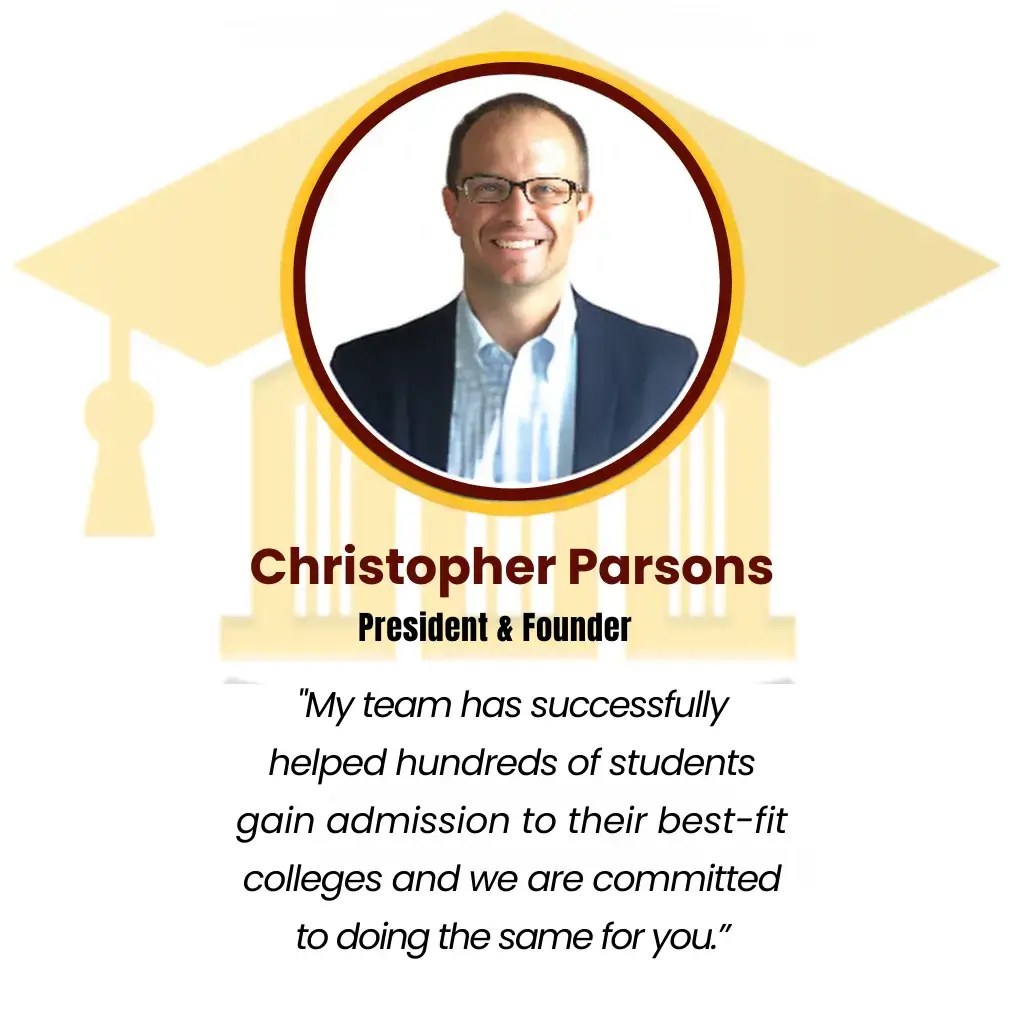
Special thanks to Christopher Parsons for writing this blog post.
Christopher has a strong educational background, including Doctoral studies in English Literature and Creative Writing, a Master’s Degree in English, and a Bachelor of Arts Degree in English and History. He also has a background in Mass Communications and Public Relations/Marketing.
He has successfully won scholarship offers from prestigious schools and over $250,000 in grants and scholarships. His real-world personal experience resonates well with today’s students.
